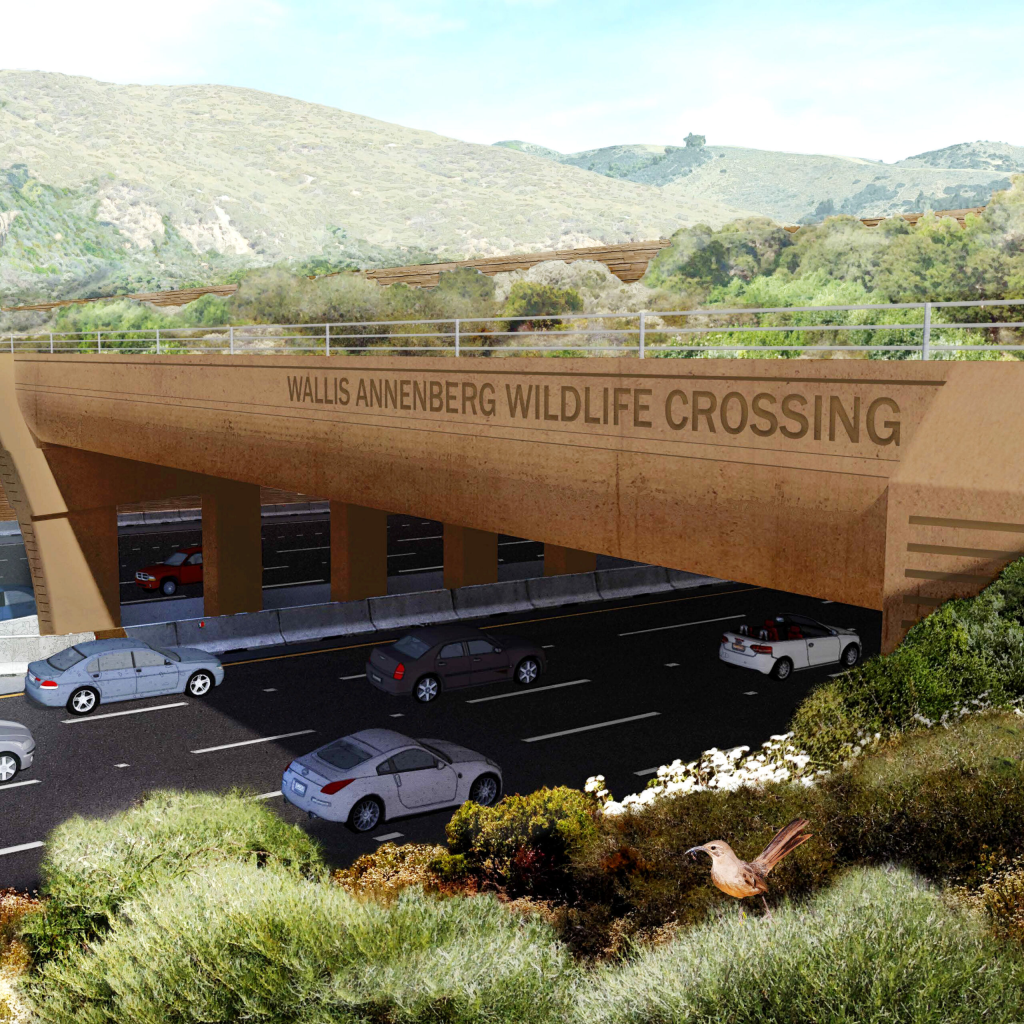
How a new bridge over the 101 freeway will save animal lives and create opportunities for increased ecosystem connectivity.
Photo credit: The Annenberg Foundation
Wildlife conservation is often thought of as a noble, yet unattainable endeavor. One that is undoubtedly important, but often considered impractical by many. Despite most of the public agreeing that such efforts are worthy of support, the ultimate goals can often seem lofty and hard to reach. This is due to a variety of factors. However, in general because human development and wildlife conservation efforts are at times in conflict. Despite ongoing conflicts, there are many positive actions currently being taken to reduce human wildlife conflicts in our own backyards.
One such place to observe the active impact of conservation may not be where you expect: the city of Los Angeles, California. Within this city, a major problem presented by human expansion into animal habitats is the ongoing development of roads and freeways. Many animals try to avoid human interaction when possible. However, this becomes more challenging as roads and development create barriers that divide habitats and increase risk of injury or death to animals. This is an especially prominent issue in Los Angeles, as highways have cut across the once larger territories of mountain lions, forcing them to either inbreed, or to risk crossing a busy road.
One such example of this problem was the recent passing of the locally famous mountain lion, P22 . P22 was humanely euthanized late last year due to a multitude of unfortunate factors, including injuries sustained from a vehicle impact on a Los Angeles highway. In addition, the first gray wolf to be sighted in southern California in 100 years was also struck and killed by a car in Los Angeles. In total, an estimated 350 million animals are killed by automobiles annually in the United States alone.
To reduce wildlife crossing related deaths, conservationists and Los Angeles officials are currently developing a new habitat corridor within their own community. The Wallis Annenberg Wildlife Crossing is a bridge being built over the 101 freeway of Los Angeles in Augora hills. This bridge will allow for wildlife to safely cross over the freeway and to avoid conflicts with humans while doing so. Construction of this habitat corridor will begin in 2022 and is expected to reach completion by 2025.
Wildlife crossings have also been successfully used in other parts of the world, such as Banff National Park in Canada. However, the Wallis Annenberg Crossing in Los Angeles will be the largest one constructed to date. This important habitat corridor will help to provide a safer environment for both humans and animals while ensuring continued city development.
Projects like the Wallis Annenberg Crossing are made possible through the cooperation of the public with local conservation organizations. While challenges with human-wildlife coexistence will persist, the Wallis Annenberg Crossing proves that it is possible to mitigate for them. However, this will require that human populations learn to work with and not against nature in the years to come.
 Frost Fund
Leave a comment